London Mayor Boris Johnson scrapped not only the £25 planned congestion charge for gas guzzlers (see post and comments here), but also the exemption for cleaner cars emitting less than 120g/km of CO2. Which means that everyone is going to pay the same £8. Hybrids and electric vehicles will still be congestion charge-exempt. I don't agree with Johnson's arguments, but I'm happy with the ditching of a predictable small "breath-my-particles-before-they-empoison-the-environment" diesels frenzy.
Showing posts with label environment. Show all posts
Showing posts with label environment. Show all posts
13.7.08
London's gas guzzlers congestion charge scrapped

28.4.08
Tempelhof referendum
After this weekend’s failed referendum, forced by Berliners wishing to keep it open, Tempelhof, the Berlin Airlift airport, used during the Cold War to support the Western part of the City, landlocked by the Soviets, will be closed in October. It’s reasonable: it’s too close to the City centre, surrounded by residential areas, and the runways are too short for modern jets. The terminal, one of the biggest buildings in Europe, built from 1936 to 1941 by Ernst Sagebiel (according to Albert Speer’s plan for rebuilding Berlin, or "Germania", the new world’s capital), should be preserved.

23.4.08
Biofuel: filling your tank with hunger
The UN is calling for action to avoid the "silent tsunami of rising food prices which threatens to push more than 100 million people worldwide into hunger" (http://www.un.org/). Protests against rising costs of basic foods already started in Haiti, Mexico, the Philippines, Bangladesh, South Africa.... Sub-Saharan Africans continue their decades-old silent protest, dying slowly, quietly, dryly.
I recall now the bad feeling I had last year when I read about Bush's visit to ethanol-driven Brazil.
 Biofuel production is said to be responsible for at least one third of the recent increase in food prices. It was already being called “deforestation fuel”. Now it’s also “hunger fuel”.
But it’s bio. «Quand je dors chez mon copain, on mange tout le temps bio» (Sanseverino, «Cette conne m'ennuie»).
16.4.08
Big political issue

The Vel'ohs are becoming the biggest political issue in Luxembourg City, which demonstrates vehemently the opposition's improficiency. First, someone asked a professional biker to test the bikes and to let us know that they're too heavy and that the brakes are not very good (who cares? they're built to be ridden at a relaxed pace, to cruise along bike paths and enjoy the ride). Now the CSV in questioning the security of payments made with credit cards at the Vel'oh stations.
5.4.08
Vel'oh! hoax
Someone at RTL Radio Luxembourg thougth that the Vel'ohs were just asking for an April Fools' Day hoax ... and shot himself in the foot!
The hoax was about swapping an old bicycle for a Vel-oh!'s annual subscription. The City decided to fight back, and play the game:
"La Ville de Luxembourg s'était inspirée de l'action «poisson d'avril» organisée par RTL Radio Lëtzebuerg le 1er avril pour proposer aux intéressés de déposer leurs vieux vélos le 2 avril entre 15h et 16h devant l'Hôtel de Ville, place Guillaume II. En contrepartie la ville a pu offrir 35 abonnements d'un an à vel'oh!
La ville projette d'utiliser tous ou une partie des vieux vélos dans le cadre de l'action «Mei oder manner», ayant pour but d'engager les enfants des écoles primaires à prendre leurs responsabilités et de susciter leur compréhension envers la nature et l'environnement.
Merci à tous ceux qui ont joué le jeu !" (in vdl.lu)
26.3.08
Vel'oh: Vade retro, satana!
The Wort has just discovered that Luxembourg and the Vel'oh bicycle system will become a lucrative business for JCDecaux, as confirmed by Jean-Sebastien Decaux, the executive director of the company.
I'm outraged. I feel betrayed. We all thought that JC Decaux was a non-profit organization, but no, it's a market economy firm.
I want to scream: "____________" (here you can choose: "¡No Pasarán!" or "Vade retro, satana!")


17.3.08
Diesel taxes in Europe
 "The European Commission says the wide variation in rates of diesel (officially known as gas oil) taxes creates distortions in the road haulage market – and also increases environmental damage by encouraging “fuel tourism” by hauliers (i.e. making special journeys or using longer routes in order to fill up in a country with low taxes). Also, since diesel and petrol have similar impacts, especially from the point of view of CO2 emissions, there is no environmental reason for the two minimum rates to differ. The Commission is therefore proposing to raise the minimum rate on diesel up to the minimum rate on petrol."
"Adopting by 447 votes in favour to 64 against with 39 abstentions a report based on a draft by Olle Schmidt (ALDE, SE), MEPs agreed with this in principle, but said the minimum taxes on diesel should rise more slowly, from the current level of €302/1000 litres to the current petrol level of €359/1000 litres by 2015 rather than 2012. Latvia, Lithuania, Poland, Bulgaria and Romania should have until 2016 to reach the target. On the other hand, contrary to the Commission proposal, MEPs said Spain, Austria, Belgium, Luxembourg, Portugal and Greece did not need a transitional period."
(in http://www.europarl.europa.eu/news/expert/infopress_page/044-23872-070-03-11-907-20080312IPR23862-10-03-2008-2008-true/default_en.htm)
(in http://www.europarl.europa.eu/news/expert/infopress_page/044-23872-070-03-11-907-20080312IPR23862-10-03-2008-2008-true/default_en.htm)
14.3.08
Think City, please (or else be Smart, or show your iQ)
 "TH!NK city demands very little of you. In fact, not much more than a mobile phone. Just an overnight power top-up, and it’s ready to go in the morning. It can travel up to 200 kilometres (124 miles) in city driving on a fully charged battery, with a top speed of 100km/h. It is fun, clean and simple."

The Th!nk City will go on sale at the end of 2008. It will run for 200 km on one charge and hit 100 km/h. The price will be around 20 000 euros, plus a 200 euros monthly fee for the battery loan scheme (the company will own the batteries, replace them when needed, and even pay you electricity and insurance bills). It's not cheap. In a 5 years (60 months) scenario, it would cost 20 000 + (60 x 200) = 32 000 euros. Now let's say that we would drive 500 km per month, which I think it's more then enough in a city like Luxembourg. That's 6000 km per year, and 30 000 in our 5 years. How much would we spend with a Citroën C1? The cheapest 1.0 costs 8 750 euros, but you can easily buy it for 7500 euros. I'm not sure about this, but I would say that it would be possible to insure it for 600 euros per year, = 3000 euros in 5 years. Plus maintenance (250 euros per year = 1250 for 5 years) and petrol (let's say 1800 euros during the whole fires years). It all adds up to 13 550 euros, almost half what we would spend with the Th!nk.

Verdict: nice Norwegian clean cute car, but you'll have to go to London to see one in the metal. Only the city congestion charge exemption will justify its price. For a city like Luxembourg, buy the Citroën. Or better: take a bus!
12.3.08
City of Luxembourg: Plan d'aménagement général (PAG)
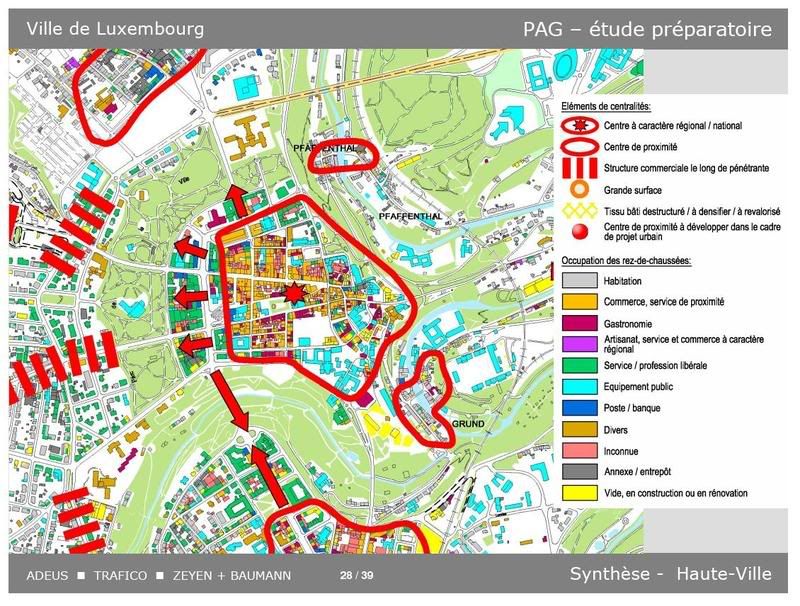
Some personal (and humble) considerations about the PAG presented the 29th of February (you can find it here):
- it's very positive to finally acknowledge that the saturation of the Hamilius-Gare axis is one of the major problems concerning public transportation in the city; the solution is, of course, to create other bus-train(-tram?) interfaces, namely in Kircheberg, Gasperich and Howald (East, South and West; the Northern entrance to the city poses a different problem, as the highway is still under construction);
- it's very positive to finally acknowledge that the saturation of the Hamilius-Gare axis is one of the major problems concerning public transportation in the city; the solution is, of course, to create other bus-train(-tram?) interfaces, namely in Kircheberg, Gasperich and Howald (East, South and West; the Northern entrance to the city poses a different problem, as the highway is still under construction);
- it's good to know that, in a country where one of the most relevant yearly "cultural" activities is the Auto-Festival, someone is planning to reduce accessibilities for cars and promote public and soft transportation (at least it shows some nerve);
- sadly, there are no plans for closing the highway ring around the city: if you're in Strassen and want to go to the airport, it's faster to drive through town, and this is not a good sign;
- a second inner ring (with a speed limit around 70-80 km/h, where possible) would help distributing the traffic coming from the highway; this function is now taken by some of the radiating axes and, what's worst, by the streets surrounding the city centre, which is not good; this would be the right place to build P&Rs and the new bus-train(-tram?) interfaces;
- is it reasonable to expect that the city will continue to grow has in the last 10 years? What will happen if banking laws and TVA are imposed and harmonized through out Europe?
- promote the installation of families in the city is not has easy has to reduce traffic or paint new bicycle lanes: people will have to be convinced that they are allowed to be part of the city, and that they can have a life outside the "oxygen bubbles" provided by the proximity of their countries of origin (for the frontaliers) or by the institutional/social support from their employers (for the European civil servants); for to really establish themselves in real Luxembourg, people need to know that they will be able to send their children to a good school, and to have European quality health care (not just cheap), and that they can go to a supermarket or shop other than Auchan and get a good friendly service even if they can only communicate using the second official language of the country. Of course this has nothing to do with traffic, but the population issue is (well) included in this "Plan d'aménagement général";
- only recently I was aware of the existence of (another) controversy about the demolition of Luxexpo to liberate some space for the tramway. I can only have one opinion about this: implode the damn thing!
10.3.08
We're saved: the Vatican has listed pollution has a new sin
... and also genetic experimentation, drug abuse, abortion, paedophilia, excessive wealth and causing social injustice. Part of this we already knew (the "do as I say, not as I do" part). But... Recycle or go to Hell!?

Tata's Nano at Geneva Motor Show

Let's be very politically incorrect: millions of Indians will get one very cute family car, and the world will get more pollution, more CO2 emissions, more demand for fossil fuels. And don't forget that when the catalytic converter fails and it's not replaced, emissions will increase fivefold.
8.3.08
MUPI in Luxembourg (like in "Martine in Luxembourg" or "Noddy in Luxembourg")
 We already knew that Santa was living in Luxembourg. After the most recent anti-MUPI fairy tale reactions (small print: "although our main business is banking, we don't want your filthy capitalist advertising in our city"), I've just been informed that Snow White is also moving into town, and she's bringing the Dwarfs with her (not all of them, Grumpy is staying in Liechtenstein; and, by the way, Bambi is still happily living in Switzerland, where he relocated to after the fall of the Weimar Republic).
(previous posts about the free bicycle system and the contract with JC Decaux here and here)
27.2.08
26.2.08
More problems with the bicycle contract in Luxembourg City
The result of all this is obvious: the City will have to loose a lot of money to honor the contract with JC Decaux, and the opposition will have a very good argument for the coming election, although they don't seem to have any solutions or a positive attitude towards pollution or traffic increase (the bicycles are not to supposed to solve any traffic or pollution problems, they're just a very good way to start changing, to say "we care, we are aware of the problem, we are doing something"). This Friday the City Council will present a preliminary study for a Plan d’aménagement général that will deal with a foreseen increase of residents, jobs and number of cars entering the city everyday. First councillor François Bausch (from the Greens, and best known for putting his money where his mouth is: I'm not the only one to see him cruising trough the city in his bicycle almost everyday) said that by 2020 the Council expects to have tripled the offer of public transportation and doubled the numbers of soft mobility (walking, cycling).
More comments (in French) here and here.
22.2.08
The new bus lane in route d'Esch
Some facts about the new most discussed bus lane in route d'Esch:
1. When you have two lanes of traffic and you decide that one of them is going to be used only by buses (and by bicycles, it seems), you can not expect that all the drivers that were previously using that lane will leave their car at home and jump into the next bus. You can expect bigger traffic jams in the only lane now open for private cars.
2. We have a diesel pollution problem (in Luxembourg, high levels of nitrogen dioxide, in Brussels, fine particles: that's the geography of money - new diesel cars with particle filters here, old diesel cars without particle filters in Belgium - both very polluting and bad for your lungs, although "environmental-friendly" and government-supported because of the lower levels of CO2).
3. When you have a pollution problem, you can not expected the average citizen to decide on his own to park his new flashy just-bought-in-the-AutoFestival-diesel-burning bagnole and take the bus or the train, because he wants to show it to all his workmates and neighbours, and taking the bus or the train is soooo working class (and we are not working class, nor immigrants, we are transfrontaliers, and expatriates).
4. You can only rely on the City Council to take the good decision of imposing bus lanes, and forcing a lot of us to use public transportation. That's what they were elected for: to implement their decisions and their political program.
 (Feel free to use this banner on your own blog)
19.2.08
Metro subway in Luxembourg
The ADR (Alternative Democratic Reform Party*) thinks that the best solution for the future of public transportation in Luxembourg would be a metro, not the tramway. The building of a subway tunnel in only three years in Leipzig is cited has an example. Leipzig has 500 000 habitants, five times more than Luxembourg (surrounding comunes included). The city tunnel was built to complete the suburban train system, and it's not a metropolitan subway. A similar project in Luxembourg would mean extending the train lines from the Gare up to Kirchberg, with an additional central station in the Centre-Ville. By the way, Leipzig's suburban tunnel is a seven years project, with the following anounced benefits: "More than 320,000 car km per day will be avoided. This will considerably increase the City’s share in short-distance public transport. Shorter travelling time between medium level centres and the city centre of Leipzig. Better connection and development of the airport, New Fair Ground, the media centre and the city centre. Better connections of the south west region of Saxony to Greater Leipzig and the city centre. Additional axis for high-speed long distance traffic from Berlin via Leipzig, Nuremberg to Munich. Positive influence on employment situation (directly and indirectly) by creating up to 1,500 jobs during the construction phase."
(in http://www.citytunnelleipzig.de/english/english_information.html)

Let's get real?
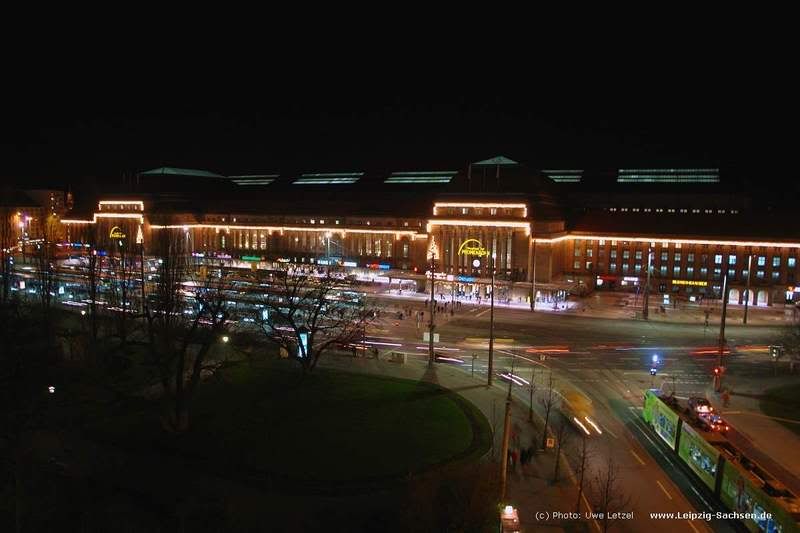
 Leipzig's Central Station is one of the largest terminus train stations in Europe. A few years ago sections of the Station were altered to house a state-of-the-art shopping and service centre.
More posts about the tramway here.
(in http://www.citytunnelleipzig.de/english/english_information.html)

Let's get real?
 Leipzig's Central Station is one of the largest terminus train stations in Europe. A few years ago sections of the Station were altered to house a state-of-the-art shopping and service centre.
More posts about the tramway here.
13.2.08
JCDecaux in Luxembourg and the bicycle contract

6.2.08
New Ecowhat?! Fiat Bravo 1.6 Diesel Multijet
 As you might recall from one of my previous posts, I have serious doubts about the so-called environment-friendly diesel cars. For example, Fiat is launching a new 1.6 diesel engine for the Bravo range, in 103 or 118bhp variants, both Euro 5 compliant, thanks to a new particle filter. AND a third “Eco” model, with the same motor, 103bhp and CO2 emissions of just 119g/km, which is not Euro 5 compliant because removing the particle filter was the only trick Fiat could find to keep CO2 emissions bellow the 120 g/km threshold. The dirty trick will not work in Luxembourg, because the 750 euros reduction from the governmental scheme for cleaner cars can only be granted for a diesel car equipped with a particle filter: “Pour les voitures équipées d’un moteur à carburant diesel, l’aide financière [750 euros] n’est accordée que si les émissions de particules fines sont inférieures ou égales à 5 mg/km, un filtre à particules est dès lors indispensable" (in car-e.lu) .
31.1.08
Cabbage smell in Luxembourg

"Most odors associated with kraft paper mills result from the use of sulfur in digesting wood and sawdust. In the digestion process some of the sulfur is converted to reduced sulfide compounds (TRS). TRS gases, which have very distinctive odors, are primarily hydrogen sulfide (H 2 S, rotten egg smell), methyl mercaptan (CH 3 SH, rotten cabbage smell), dimethyl sulfide (CH 3 SCH 3 , rotten vegetable smell), and dimethyl disulfide (CH 3 S 2 CH 3, rotten vegetable smell)."
18.1.08
Dirty skies
 Air in Luxembourg City is dirty, and getting dirtier. The average level of nitrogen oxides is around 50 mcg in Hamilius and Bonnevoie, above the european limit of 40 micrograms per cubic meter. Nitrogen oxides means diesel cars.
Because of the way a diesel engine works, with an excess of air inside the engine (rather than "just enough" as in a petrol engine, which is what causes CO emissions), nitrous oxides are more likely to be formed. The nitrous oxides combine with low level ozone to form smog. Diesel engines emit high levels of nitrogen oxides (NOx) and particulate matter (PM), and in addition, a complex mixture of gases many of which are known or suspected cancer causing agents. Diesel exhaust exacerbates asthma and causes inflammation of the airways. Diesel exhaust is an important contributor to airborne concentrations of fine particle pollution, especially in urban areas.
This means that most european governments are supporting (fiscally or directly) low CO2 emitting diesel cars that are still responsible for deteriorating air quality in major cities. Since diesel versions are more expensive them the petrol versions of the same model, I guess the auto industry bosses most be happy.
Subscribe to:
Posts (Atom)