London Mayor Boris Johnson scrapped not only the £25 planned congestion charge for gas guzzlers (see post and comments here), but also the exemption for cleaner cars emitting less than 120g/km of CO2. Which means that everyone is going to pay the same £8. Hybrids and electric vehicles will still be congestion charge-exempt. I don't agree with Johnson's arguments, but I'm happy with the ditching of a predictable small "breath-my-particles-before-they-empoison-the-environment" diesels frenzy.
Showing posts with label public transportation. Show all posts
Showing posts with label public transportation. Show all posts
13.7.08
London's gas guzzlers congestion charge scrapped

9.6.08
Tramway invading Limpertsberg
According to L'Essentiel, the "syndicat du Limpertsberg" is protesting against the fact that the tramway is going to corrupt their very nice neighbourhood. They were not consulted, and they call it "an invasion".
At the same time, at http://service.vdl.lu/forum/read.php?4,4102,4103#msg-4103 (the City of Luxembourg online forum) someone is asking for a direct bus line between Limpertsberg and Kirchberg. Others demand for more peripheral direct connections (meaning: if you don't live near Centre Hammilius or the Gare, chances are that you'll have to take two different buses to go anywhere).

Me, I've never been to the Limpertsberg village. I'm a city guy and I fell sick in deserted open spaces, full of cows and ticks, but I do believe that if people have chosen to live in the countryside, away from the turbulent city centre, they should be respected.
More posts about the tramway here.
16.4.08
Big political issue

The Vel'ohs are becoming the biggest political issue in Luxembourg City, which demonstrates vehemently the opposition's improficiency. First, someone asked a professional biker to test the bikes and to let us know that they're too heavy and that the brakes are not very good (who cares? they're built to be ridden at a relaxed pace, to cruise along bike paths and enjoy the ride). Now the CSV in questioning the security of payments made with credit cards at the Vel'oh stations.
5.4.08
Vel'oh! hoax
Someone at RTL Radio Luxembourg thougth that the Vel'ohs were just asking for an April Fools' Day hoax ... and shot himself in the foot!
The hoax was about swapping an old bicycle for a Vel-oh!'s annual subscription. The City decided to fight back, and play the game:
"La Ville de Luxembourg s'était inspirée de l'action «poisson d'avril» organisée par RTL Radio Lëtzebuerg le 1er avril pour proposer aux intéressés de déposer leurs vieux vélos le 2 avril entre 15h et 16h devant l'Hôtel de Ville, place Guillaume II. En contrepartie la ville a pu offrir 35 abonnements d'un an à vel'oh!
La ville projette d'utiliser tous ou une partie des vieux vélos dans le cadre de l'action «Mei oder manner», ayant pour but d'engager les enfants des écoles primaires à prendre leurs responsabilités et de susciter leur compréhension envers la nature et l'environnement.
Merci à tous ceux qui ont joué le jeu !" (in vdl.lu)
26.3.08
Vel'oh: Vade retro, satana!
The Wort has just discovered that Luxembourg and the Vel'oh bicycle system will become a lucrative business for JCDecaux, as confirmed by Jean-Sebastien Decaux, the executive director of the company.
I'm outraged. I feel betrayed. We all thought that JC Decaux was a non-profit organization, but no, it's a market economy firm.
I want to scream: "____________" (here you can choose: "¡No Pasarán!" or "Vade retro, satana!")


14.3.08
Think City, please (or else be Smart, or show your iQ)
 "TH!NK city demands very little of you. In fact, not much more than a mobile phone. Just an overnight power top-up, and it’s ready to go in the morning. It can travel up to 200 kilometres (124 miles) in city driving on a fully charged battery, with a top speed of 100km/h. It is fun, clean and simple."

The Th!nk City will go on sale at the end of 2008. It will run for 200 km on one charge and hit 100 km/h. The price will be around 20 000 euros, plus a 200 euros monthly fee for the battery loan scheme (the company will own the batteries, replace them when needed, and even pay you electricity and insurance bills). It's not cheap. In a 5 years (60 months) scenario, it would cost 20 000 + (60 x 200) = 32 000 euros. Now let's say that we would drive 500 km per month, which I think it's more then enough in a city like Luxembourg. That's 6000 km per year, and 30 000 in our 5 years. How much would we spend with a Citroën C1? The cheapest 1.0 costs 8 750 euros, but you can easily buy it for 7500 euros. I'm not sure about this, but I would say that it would be possible to insure it for 600 euros per year, = 3000 euros in 5 years. Plus maintenance (250 euros per year = 1250 for 5 years) and petrol (let's say 1800 euros during the whole fires years). It all adds up to 13 550 euros, almost half what we would spend with the Th!nk.

Verdict: nice Norwegian clean cute car, but you'll have to go to London to see one in the metal. Only the city congestion charge exemption will justify its price. For a city like Luxembourg, buy the Citroën. Or better: take a bus!
12.3.08
City of Luxembourg: Plan d'aménagement général (PAG)
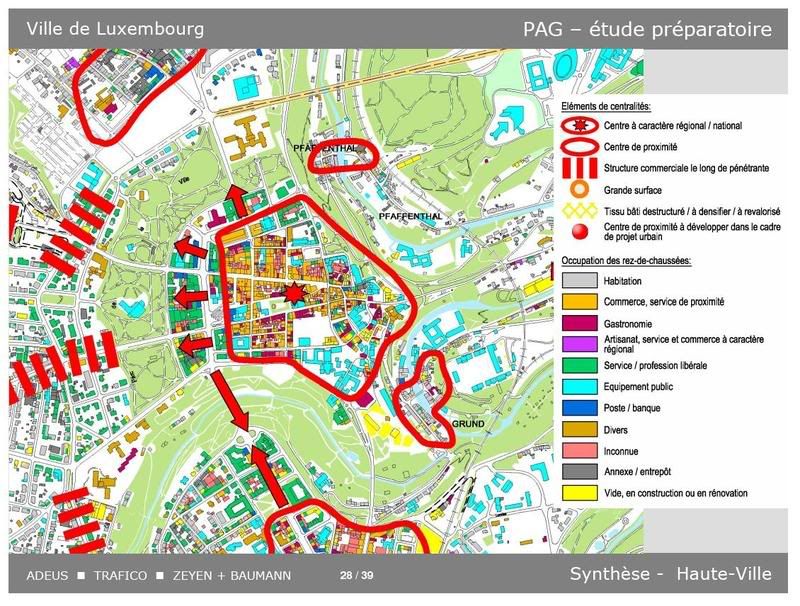
Some personal (and humble) considerations about the PAG presented the 29th of February (you can find it here):
- it's very positive to finally acknowledge that the saturation of the Hamilius-Gare axis is one of the major problems concerning public transportation in the city; the solution is, of course, to create other bus-train(-tram?) interfaces, namely in Kircheberg, Gasperich and Howald (East, South and West; the Northern entrance to the city poses a different problem, as the highway is still under construction);
- it's very positive to finally acknowledge that the saturation of the Hamilius-Gare axis is one of the major problems concerning public transportation in the city; the solution is, of course, to create other bus-train(-tram?) interfaces, namely in Kircheberg, Gasperich and Howald (East, South and West; the Northern entrance to the city poses a different problem, as the highway is still under construction);
- it's good to know that, in a country where one of the most relevant yearly "cultural" activities is the Auto-Festival, someone is planning to reduce accessibilities for cars and promote public and soft transportation (at least it shows some nerve);
- sadly, there are no plans for closing the highway ring around the city: if you're in Strassen and want to go to the airport, it's faster to drive through town, and this is not a good sign;
- a second inner ring (with a speed limit around 70-80 km/h, where possible) would help distributing the traffic coming from the highway; this function is now taken by some of the radiating axes and, what's worst, by the streets surrounding the city centre, which is not good; this would be the right place to build P&Rs and the new bus-train(-tram?) interfaces;
- is it reasonable to expect that the city will continue to grow has in the last 10 years? What will happen if banking laws and TVA are imposed and harmonized through out Europe?
- promote the installation of families in the city is not has easy has to reduce traffic or paint new bicycle lanes: people will have to be convinced that they are allowed to be part of the city, and that they can have a life outside the "oxygen bubbles" provided by the proximity of their countries of origin (for the frontaliers) or by the institutional/social support from their employers (for the European civil servants); for to really establish themselves in real Luxembourg, people need to know that they will be able to send their children to a good school, and to have European quality health care (not just cheap), and that they can go to a supermarket or shop other than Auchan and get a good friendly service even if they can only communicate using the second official language of the country. Of course this has nothing to do with traffic, but the population issue is (well) included in this "Plan d'aménagement général";
- only recently I was aware of the existence of (another) controversy about the demolition of Luxexpo to liberate some space for the tramway. I can only have one opinion about this: implode the damn thing!
- sadly, there are no plans for closing the highway ring around the city: if you're in Strassen and want to go to the airport, it's faster to drive through town, and this is not a good sign;
- a second inner ring (with a speed limit around 70-80 km/h, where possible) would help distributing the traffic coming from the highway; this function is now taken by some of the radiating axes and, what's worst, by the streets surrounding the city centre, which is not good; this would be the right place to build P&Rs and the new bus-train(-tram?) interfaces;
- is it reasonable to expect that the city will continue to grow has in the last 10 years? What will happen if banking laws and TVA are imposed and harmonized through out Europe?
- promote the installation of families in the city is not has easy has to reduce traffic or paint new bicycle lanes: people will have to be convinced that they are allowed to be part of the city, and that they can have a life outside the "oxygen bubbles" provided by the proximity of their countries of origin (for the frontaliers) or by the institutional/social support from their employers (for the European civil servants); for to really establish themselves in real Luxembourg, people need to know that they will be able to send their children to a good school, and to have European quality health care (not just cheap), and that they can go to a supermarket or shop other than Auchan and get a good friendly service even if they can only communicate using the second official language of the country. Of course this has nothing to do with traffic, but the population issue is (well) included in this "Plan d'aménagement général";
- only recently I was aware of the existence of (another) controversy about the demolition of Luxexpo to liberate some space for the tramway. I can only have one opinion about this: implode the damn thing!
22.2.08
The new bus lane in route d'Esch
Some facts about the new most discussed bus lane in route d'Esch:
1. When you have two lanes of traffic and you decide that one of them is going to be used only by buses (and by bicycles, it seems), you can not expect that all the drivers that were previously using that lane will leave their car at home and jump into the next bus. You can expect bigger traffic jams in the only lane now open for private cars.
2. We have a diesel pollution problem (in Luxembourg, high levels of nitrogen dioxide, in Brussels, fine particles: that's the geography of money - new diesel cars with particle filters here, old diesel cars without particle filters in Belgium - both very polluting and bad for your lungs, although "environmental-friendly" and government-supported because of the lower levels of CO2).
3. When you have a pollution problem, you can not expected the average citizen to decide on his own to park his new flashy just-bought-in-the-AutoFestival-diesel-burning bagnole and take the bus or the train, because he wants to show it to all his workmates and neighbours, and taking the bus or the train is soooo working class (and we are not working class, nor immigrants, we are transfrontaliers, and expatriates).
4. You can only rely on the City Council to take the good decision of imposing bus lanes, and forcing a lot of us to use public transportation. That's what they were elected for: to implement their decisions and their political program.
 (Feel free to use this banner on your own blog)
19.2.08
Metro subway in Luxembourg
The ADR (Alternative Democratic Reform Party*) thinks that the best solution for the future of public transportation in Luxembourg would be a metro, not the tramway. The building of a subway tunnel in only three years in Leipzig is cited has an example. Leipzig has 500 000 habitants, five times more than Luxembourg (surrounding comunes included). The city tunnel was built to complete the suburban train system, and it's not a metropolitan subway. A similar project in Luxembourg would mean extending the train lines from the Gare up to Kirchberg, with an additional central station in the Centre-Ville. By the way, Leipzig's suburban tunnel is a seven years project, with the following anounced benefits: "More than 320,000 car km per day will be avoided. This will considerably increase the City’s share in short-distance public transport. Shorter travelling time between medium level centres and the city centre of Leipzig. Better connection and development of the airport, New Fair Ground, the media centre and the city centre. Better connections of the south west region of Saxony to Greater Leipzig and the city centre. Additional axis for high-speed long distance traffic from Berlin via Leipzig, Nuremberg to Munich. Positive influence on employment situation (directly and indirectly) by creating up to 1,500 jobs during the construction phase."
(in http://www.citytunnelleipzig.de/english/english_information.html)

Let's get real?
 Leipzig's Central Station is one of the largest terminus train stations in Europe. A few years ago sections of the Station were altered to house a state-of-the-art shopping and service centre.
More posts about the tramway here.
(in http://www.citytunnelleipzig.de/english/english_information.html)

Let's get real?
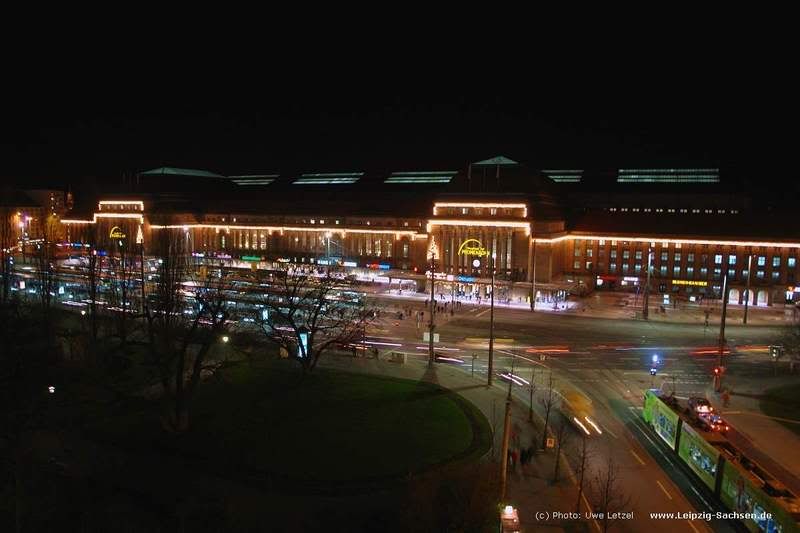 Leipzig's Central Station is one of the largest terminus train stations in Europe. A few years ago sections of the Station were altered to house a state-of-the-art shopping and service centre.
More posts about the tramway here.
31.12.07
New Year's Eve
Luxembourg is definitely not a city that never sleeps. Au contraire. Therefore, it's always nice to find out that someone is still alive. And kicking (another cliché, or another French expression, and I’ll close this thing down). Mr. Paul Hammelmann, president of Luxembourguish Sécurité routiére, gave an interview to L’Essentiel defending the need for free public transportation in Luxembourg during New Year's Eve (click to read):
It all looks like a small domestic war between the government, the city administration, and probably CFL. In vdl.lu we learn that:
"Comme tous les ans à l'occasion des fêtes de fin d'année, le service des autobus municipaux interrompra ses courses comme suit:
- Le mardi 1er janvier 2008 (Nouvel An) le service des lignes régulières ne commencera que vers 08h00."
But:
"Le service nocturne des autobus «City Night Bus» de la Ville de Luxembourg circule suivant son horaire habituel les vendredi et samedis soirs.
Le City Night Bus circule sur les trois lignes suivantes:
- CN1 P+R Bouillon - Gare Centrale - Centre E. Hamilius - Clausen - Cents et retour, toutes les 15 minutes entre 22.15 et 03.15 heures;
- CN2 Centre E. Hamilius - Limpertsberg - Belair - Merl, toutes les 30 minutes entre 00.00 et 03:30 heures;
- CN3 Centre E. Hamilius - Bonnevoie - Gasperich - Cessange, toutes les 30 minutes entre 00.00 et 03.30 heures.
Lors du réveillon du Nouvel An (St Sylvestre), dans la nuit du lundi 31/12/2007 au mardi 01/01/2008, le service est assuré jusqu'à 06h30 du matin (dernier départ Centre E. Hamilius)."

Good news. Now back to the interview: Where the hell do they find these journalists?
How can you use the word "paternalize" when talking to someone responsible for trying to save people's life? "Should we care for those who drink to much, or just let them kill themselves?" What?
Subscribe to:
Posts (Atom)